
- Compare agents
- Online valuation
- Explore my area
- Home toolkit
- News & guides


- Estate agents by area
- Sold house prices by area
- Estate Agent ValuationRequest an in-person valuation with an agent to discover your property's true market value.
- Online Valuation ToolGet a free instant estimate of your home's value.
- EPC CheckerFind out if your home has a valid Energy Performance Certificate.
- Listing MonitorAlready on the market? See how your online property advert is performing.
- Estate Agent Fee CalculatorSee typical local agent fees, including VAT.
- Cost of Selling CalculatorPlan your budget for agent fees, legal work and moving.
- Stamp Duty CalculatorEstimate SDLT, LBTT or LTT for your next purchase.
- Selling guides
- Estate agent guides
- Mortgage advice
- Conveyancing guides
- Property news See All News & Guides
Agent shortlist
HouseWorth
- Is council tax a utility bill?
Estimated reading time: 13 minutes
Table of contents
- 1. At a glance
- 2. What this guide covers
- 3. Is council tax a utility bill? The short answer
- 4. What is a utility bill?
- 5. What is council tax?
- 6. Council tax vs utility bills: the key differences
- 7. How council tax is calculated in 2026
- 8. Who pays council tax and who is exempt
- 9. Council tax in Wales and Scotland
- 10. Does council tax count as a utility bill for proof of address?
- 11. What happens when you move home
- 12. How council tax affects selling a home
- 13. Practical takeaways
- 14. References
- 15. FAQs
At a glance
Is council tax a utility bill? No, council tax is a local property tax collected by your local authority to fund public services like schools, refuse collection and policing. A utility bill is a charge from a private supplier for a service you use, such as gas, electricity, water or broadband. The two are billed separately, regulated differently and treated differently for proof of address and budgeting purposes. Understanding the distinction matters when moving home, applying for credit or selling a property.
What this guide covers
The question "Is council tax a utility bill?" sounds straightforward, but it crops up in surprisingly important contexts. Banks, letting agents, mortgage lenders and even universities all ask for proof of address, and the rules about what counts as a utility bill, what counts as a tax document and what counts as neither can change the answer you need to give.
This guide explains where council tax sits in the UK billing system in 2026, how it is calculated, who is exempt, how it differs from genuine utility bills, and what that means when you are buying, selling or moving home. If you are weighing up a sale and want to compare local agents on real performance data, you can also use the GetAgent comparison tool to see which agents have the strongest performance selling homes in your area.
Is council tax a utility bill? The short answer
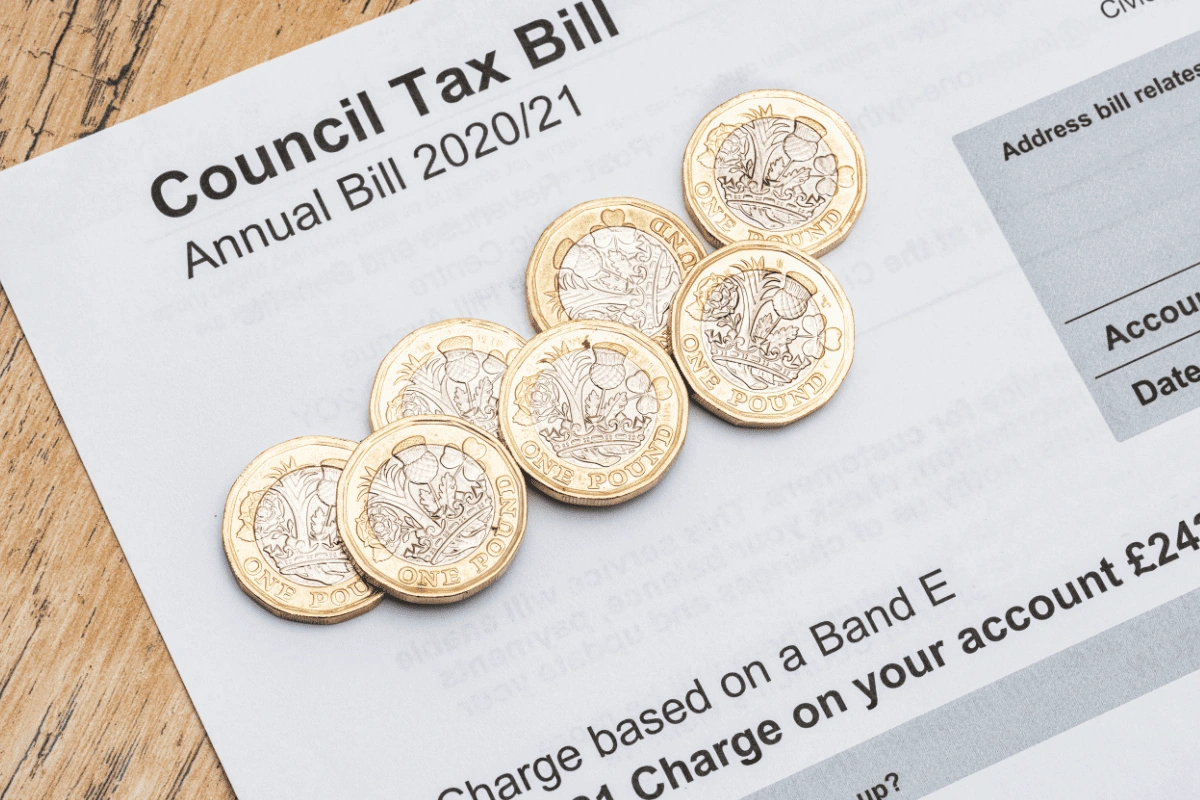
No. Council tax is not a utility bill. It is a statutory local tax set under the Local Government Finance Act 1992 and administered by your local council. Utility bills, by contrast, are commercial charges from regulated private suppliers for goods or services you consume.
The confusion is understandable. Council tax arrives monthly, lands in the same pile of post as the gas bill, and feels like just another running cost of living in a home. But the question "Is a council tax bill a utility bill?" matters in three practical situations:
- Proving your address for a bank, mortgage, employer or solicitor
- Budgeting for a new home or rental property
- Completing forms that ask you to list "utility bills" separately from "council tax"
In all three cases, getting the classification right saves time and avoids rejected applications. The answer to "Does council tax count as a utility bill?" is the same wherever you ask it in the UK: no, but it is widely accepted as proof of address in its own right.
What is a utility bill?
A utility bill is a charge from a regulated private supplier for an essential household service, billed according to usage. The amount fluctuates with how much you consume.
In the UK, the most common utility bills are:
| Type of bill | Service provided | How it is charged |
|---|---|---|
| Electricity | Power to the property | Per kilowatt hour used, plus standing charge |
| Gas | Heating and hot water | Per kilowatt hour used, plus standing charge |
| Water and sewerage | Mains supply and drainage | Metered or rateable value |
| Broadband and landline | Internet and phone services | Fixed monthly tariff |
| Mobile phone | Cellular service | Tariff or pay as you go |
Energy supply is regulated by Ofgem, water by Ofwat, and telecoms by Ofcom. These regulators set the rules suppliers must follow on pricing, billing and customer protection. Households can usually switch suppliers to find a better deal, which is one of the features that distinguishes utilities from council tax.
When a bank or solicitor asks for a "utility bill" as proof of address, they generally mean one of these. According to Citizens Advice, the document needs to show your full name, your current address and a recent issue date, usually within the last three months.
What is council tax?
Council tax is a compulsory local tax on residential property. It is set out in the Local Government Finance Act 1992, which you can read in full on legislation.gov.uk. Every domestic property in England, Scotland and Wales is allocated to a council tax band based on its capital value at a fixed historical date, and each local council sets its own annual rate for each band.
Council tax is collected by your local authority and used to fund services that benefit the whole community, not just the household paying the bill. According to gov.uk, these typically include:
- Schools and education services
- Refuse and recycling collection
- Roads, street lighting and highway maintenance
- Libraries, parks and leisure facilities
- Adult social care
- Police and fire services (collected via separate precepts)
Because the money pays for services everyone in the area uses, the bill does not vary with how much rubbish you throw out, how often you visit the library or whether anyone in the household goes to school. It is fixed by the property band and the local rate, not by household consumption.
Council tax vs utility bills: the key differences
Asking "Is a council tax utility bill?" is really asking how the two categories of payment differ. The contrast is clearest when laid out side by side.
| Feature | Council tax | Utility bills |
|---|---|---|
| What it is | Statutory local tax | Commercial charge for a service |
| Set by | Local authority, within national rules | Private supplier, regulated by Ofgem, Ofwat or Ofcom |
| Based on | Property valuation band | Amount of energy, water or data used |
| Variable amount | No - fixed for the year | Yes - changes with consumption |
| Can you switch providers | No | Yes, in most cases |
| Legal basis | Local Government Finance Act 1992 | Contract with the supplier |
| Exemptions | Yes - students, single occupants, others | Limited, usually hardship schemes |
| Paid to | Local council | Private company |
The bottom line: utility bills reflect what you use. Council tax reflects where you live and the value of your property.
How council tax is calculated in 2026
Each property in England and Scotland is placed in one of eight council tax bands (A to H) based on its estimated market value on 1 April 1991. Wales has nine bands (A to I) based on values as at 1 April 2003. The Valuation Office Agency, part of HMRC, sets these bands in England and Wales; in Scotland, the Scottish Assessors Association handles valuations.
Band D is the reference point. Every other band is calculated as a fixed proportion of the Band D charge:
| Band | Property value in 1991 (England) | Ratio to Band D |
|---|---|---|
| A | Up to £40,000 | 6/9 |
| B | £40,001 to £52,000 | 7/9 |
| C | £52,001 to £68,000 | 8/9 |
| D | £68,001 to £88,000 | 9/9 |
| E | £88,001 to £120,000 | 11/9 |
| F | £120,001 to £160,000 | 13/9 |
| G | £160,001 to £320,000 | 15/9 |
| H | Over £320,000 | 18/9 |
For the 2026/27 financial year, most English councils raised their council tax close to the maximum 4.99% permitted without a referendum (2.99% on the main element plus a 2% adult social care precept). Kensington and Chelsea, for example, applied the full 4.99% increase. Greater London households also pay a Greater London Authority precept on top of the borough rate.
You can check your property's band by entering your postcode at gov.uk/council-tax-bands. If you believe your band is wrong, the Valuation Office Agency allows you to challenge it for free.
Who pays council tax and who is exempt
Council tax is normally paid by the resident over 18 who has the strongest legal interest in the property, in this order:
- Resident freeholder
- Resident leaseholder
- Resident tenant
- Resident licensee
- Other resident
- Non-resident owner (for empty properties)
A number of important exemptions and discounts apply in 2026:
| Status | Treatment | Effect on the bill |
|---|---|---|
| Sole adult occupant | Single-person discount | 25% off |
| All occupants are full-time students | Class N exemption | 100% off |
| Property in student halls | Class M exemption | 100% off |
| Severely mentally impaired resident living alone | Disregarded | Often 100% off |
| Property left empty after death | Class F exemption | Up to 6 months after probate |
| Annexe occupied by a dependent relative | Class W exemption | 100% off |
Full-time students are "disregarded" for council tax purposes if their course lasts at least one calendar or academic year and involves at least 21 hours of study per week, according to Citizens Advice. If the property is occupied entirely by full-time students, it is exempt from council tax altogether.
Council Tax Reduction (formerly Council Tax Benefit) is also available for households on low incomes. Each council sets its own scheme, so the level of help varies by area. You apply through your local authority, not HMRC.
Council tax in Wales and Scotland
The system works slightly differently across the UK.
In Wales, properties were revalued in 2003 and use nine bands (A to I). Council tax is set within a framework agreed by the Welsh Government, with each of the 22 Welsh councils choosing its own Band D rate. The Welsh Government has also been consulting on further reform of the banding system.
In Scotland, the eight-band system uses 1991 values, the same as England. However, Scottish councils set their own rates within Scottish Government rules, and there are differences in the ratios between bands above Band D.
Northern Ireland does not use the council tax at all. Instead, households pay Domestic Rates, calculated on the capital value of the property as assessed in 2005.
If you are selling a property and want to understand how council tax affects buyer interest in your area, comparing local agents on their average sale times and percentage of asking price achieved can be a useful place to start. You can read more in our guide to choosing the right estate agent for your local market.
Does council tax count as a utility bill for proof of address?
This is one of the most common practical reasons people ask whether council tax counts as a utility bill. The good news is that for proof of address purposes, the answer is usually yes - but as a separate, accepted document, not as a utility bill itself.
According to the Royal Borough of Kensington and Chelsea's guidance, most organisations accept "your most recent council tax bill dated within the last 12 months" as proof of address. Banks, solicitors and government bodies almost always list council tax bills alongside utility bills as an acceptable document under their Anti-Money Laundering (AML) and Know Your Customer (KYC) checks.
There is one important nuance. If a form specifies that you must provide "two recent utility bills", a council tax bill may not satisfy that exact wording, because it is not technically a utility bill. In that case, you would need two genuine utility bills (gas, electricity, water) instead. However, if the form says "a utility bill or council tax bill", either will do.
| Document | Typically accepted as proof of address | Validity period |
|---|---|---|
| Gas or electricity bill | Yes | Last 3 months |
| Water bill | Yes | Last 6 months |
| Council tax bill | Yes | Current council tax year |
| Bank or building society statement | Yes | Last 3 months |
| Mortgage statement | Yes | Last 12 months |
| Tenancy agreement | Sometimes | Current tenancy |
| Mobile phone bill | Rarely | N/A |
| Passport | No - identity only | N/A |
When in doubt, check the organisation's website or call ahead. Each one sets its own rules.
What happens when you move home
Council tax follows the property, but the liability follows the occupant. When you move into a new home, you become liable for council tax from the day you move in (or the day the tenancy starts, whichever is earlier). You should tell both your old and new councils. Most authorities now accept this online and will issue a closing bill for your old address and a fresh bill for the new one.
Utility bills work differently. You contact your supplier (or set up a new account) and provide a meter reading. The supplier then bills you from that meter reading onwards. You can switch suppliers at any time, subject to your contract terms.
Because the two categories work differently, missing one when you move can cause problems. According to National Trading Standards Estate Agency Team guidance, sellers must provide accurate information about a property's council tax band and running costs as part of the Material Information requirements. Your estate agent will usually help compile this, which is one reason it pays to work with a professional whose performance reflects experience in your local area.
How council tax affects selling a home
Council tax is not directly a selling cost, but it shows up in the buyer journey in several ways:
- Listings on major property portals now display the council tax band, so buyers know the band before they enquire
- Material Information disclosures require sellers to state the band and the current annual charge
- Mortgage affordability checks factor in council tax as a fixed monthly outgoing alongside utility bills
- High-band properties sometimes attract a smaller buyer pool because of the higher running costs
According to GetAgent's research, the average estate agent fee in the UK is 1.18% plus VAT (1.42% including VAT), with fees ranging from 0.75% to around 3% plus VAT depending on the agent, the location and the level of service. Different agent types charge differently, and the right fee level is the one where the agent's performance justifies what they charge. Choosing an agent whose past results match your goals tends to matter more than the headline percentage.
Over 1.2 million UK homeowners have used GetAgent to compare local estate agents by real performance data: average sale time, percentage of asking price achieved and fee. If you are considering selling, looking at this data alongside your council tax band can help you build a realistic picture of the full cost and timeline of the move.
Practical takeaways
If you are still wondering, "Is council tax a utility bill?", here is the summary in one line: no, but it is widely accepted alongside utility bills as proof of address.
For everyday purposes:
- Treat council tax as a fixed annual property tax, not a usage charge
- Keep your most recent bill safe for proof of address checks
- Check your band at gov.uk if you suspect it is wrong - successful challenges can reduce your bill
- Tell both your old and new councils when you move home
- Factor council tax into your monthly budget alongside gas, electricity, water and broadband
References
FAQs
No, council tax is not classed as a utility bill in the UK. Utility bills are commercial charges from regulated private suppliers (such as gas, electricity, water or broadband companies) and vary according to how much of the service you use. Council tax is a statutory local property tax set by your local authority under the Local Government Finance Act 1992. It is calculated using your property's council tax band, not your household consumption. The two are billed separately and serve very different purposes, although both are recognised forms of proof of address by most banks, employers and solicitors when dated correctly.
For proof of address purposes, most UK organisations treat a council tax bill as an acceptable document in its own right, listed separately from utility bills. Banks, mortgage lenders, employers and solicitors generally accept your most recent council tax bill if it is for the current financial year and clearly shows your full name and address. However, if a form specifies "two utility bills" rather than "a utility bill or council tax bill", you may need to provide actual utility bills instead. Always check the specific requirements before submitting documents, as rules vary between organisations.
Council tax is not considered a utility bill because it is a tax rather than a charge for a service you consume. Utility bills are issued by private suppliers regulated by Ofgem, Ofwat or Ofcom, and the amount depends on usage. Council tax is set by your local council under national legislation, funds shared public services (such as refuse collection, schools and policing) and stays the same regardless of how much you personally use those services. You also cannot switch council tax providers in the way you can switch energy or broadband suppliers, because there is only one local authority for each property.
In the UK, utility bills typically include gas, electricity, water and sewerage, landline phone and broadband. Some organisations also accept mobile phone bills, but many financial institutions specifically exclude them because mobile contracts are not tied to a fixed property address. To count as a utility bill for proof of address, the document usually needs to be dated within the last three months, show your full name and your current address, and come from a recognised supplier. According to Citizens Advice, these documents are most often used for opening bank accounts, applying for credit and confirming identity for regulatory checks.
Yes, most UK banks and building societies accept a council tax bill as proof of address. Typically, the bill must be for the current council tax year (running from April to March) and clearly show your full name and current address. Many banks specifically list council tax bills alongside utility bills, bank statements and mortgage statements as acceptable documents. Some banks will accept a digital PDF, while others require a paper original. Since the Economic Crime and Corporate Transparency Act 2023, verification requirements have become stricter, so it is worth confirming the exact rules with your bank before submitting any documents.
Full-time students are "disregarded" for council tax purposes, which means they are not counted as adults when calculating the bill. If a property is occupied entirely by full-time students, it is fully exempt from council tax under Class N (private rented) or Class M (student halls). If a student lives with one non-student, the non-student is liable but receives a 25% single person discount because the student is disregarded. To qualify, the course must usually last at least one academic year and involve at least 21 hours of study per week. Students apply through their local council with a council tax certificate from their university or college.
Council tax is calculated by placing each property in a band (A to H in England and Scotland, A to I in Wales) based on its capital value at a fixed historical date. The Valuation Office Agency sets the bands in England and Wales, and the Scottish Assessors Association does so in Scotland. Each local council then sets its own annual Band D rate, with other bands paid as a fixed proportion of Band D. The total bill includes precepts from other authorities, such as the police, fire service and (in London) the Greater London Authority. You can check your band for free at gov.uk/council-tax-bands.
Yes. If you believe your property is in the wrong band, you can challenge it through the Valuation Office Agency in England and Wales, or the Scottish Assessors Association in Scotland. The process is free. You will need evidence, such as the bands assigned to similar neighbouring properties or sale prices of comparable homes around the 1991 (or 2003 in Wales) valuation date. If your challenge is successful, your band will be lowered and your bill reduced. Refunds may be backdated to when you first became liable. If the VOA rejects your case, you can appeal to the independent Valuation Tribunal within three months of the decision.
Council tax does not directly affect the sale price of a property, but it does feature in the buyer's decision-making. The band is now shown on property listings on major property portals, and sellers are required to disclose the band and annual charge as part of the Material Information rules overseen by National Trading Standards. Mortgage lenders also include council tax in affordability calculations, so a higher band may slightly affect the size of mortgage a buyer can secure. Working with an experienced local estate agent helps ensure these details are presented clearly. You can compare agents in your area through GetAgent's free comparison tool.
How much
is your home worth?
It’s always worth knowing the value of your home. Discover the price of your property with an instant valuation. GetAgent tracks the figures, so you don’t have to.
How much
is your home worth?
It’s always worth knowing the value of your home. Discover the price of your property with an instant valuation. GetAgent tracks the figures, so you don’t have to.

Compare estate agents
It takes 2 minutes.





Get in touch
020 3608 6556
Our lines are closed
We are a company registered in England & Wales, company number 09428979.
Copyright © 2026 GetAgent Limited