
- Compare agents
- Online valuation
- Explore my area
- Home toolkit
- News & guides


- Estate agents by area
- Sold house prices by area
- Estate Agent ValuationRequest an in-person valuation with an agent to discover your property's true market value.
- Online Valuation ToolGet a free instant estimate of your home's value.
- EPC CheckerFind out if your home has a valid Energy Performance Certificate.
- Listing MonitorAlready on the market? See how your online property advert is performing.
- Estate Agent Fee CalculatorSee typical local agent fees, including VAT.
- Cost of Selling CalculatorPlan your budget for agent fees, legal work and moving.
- Stamp Duty CalculatorEstimate SDLT, LBTT or LTT for your next purchase.
- Selling guides
- Estate agent guides
- Mortgage advice
- Conveyancing guides
- Property news See All News & Guides
Agent shortlist
HouseWorth
- How far can you extend without planning permission?
Advice about properties06 October 2025
How far can you extend without planning permission?
Sam Edwards
Content Marketing Manager
Estimated reading time: 5 minutes
Table of contents
- 1. What Are Permitted Development Rights?
- 2. Rear Extensions: Maximum Depth Limits
- 3. Side Extensions: Permitted Dimensions
- 4. Single-Storey vs Two-Storey Extensions
- 5. Conditions for All Permitted Development Extensions
- 6. Prior Approval Process
- 7. When to Apply for Planning Permission
- 8. Tips to Maximise Permitted Development Potential
- 9. Common Pitfalls to Avoid
- 10. Conclusion
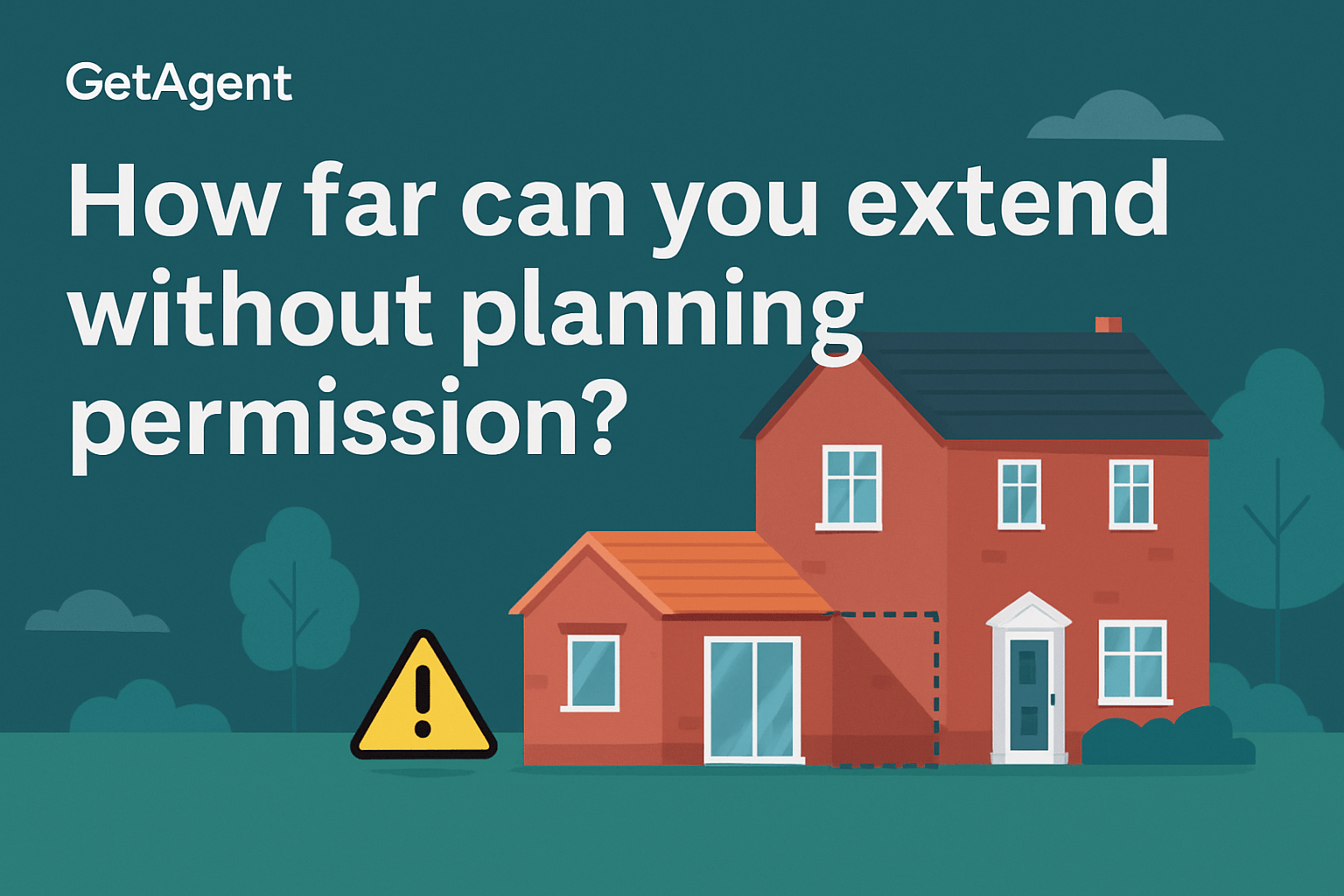
As you consider adding extra living space, a home office, or perhaps extending your kitchen, one of the most common questions is: how far can you extend without planning permission? Understanding the rules around permitted development (PD) rights in the UK is essential to avoid unexpected costs, enforcement notices, or even the need to demolish unauthorised work. This guide dives into the limits, conditions, and best practices for extending your home without applying for planning permission.
What Are Permitted Development Rights?
Permitted development rights allow homeowners to make certain types of improvements without submitting a full planning application to their local authority. These rights are automatically granted under planning legislation, but they come with strict conditions and limits. Exceeding those triggers the need to apply for planning permission.
Key benefits of permitted development rights:
- Faster approval process
- No planning application fees
- Reduced risk of delays
However, some properties (listed buildings, conservation areas, and designated sites) may have restricted or removed PD rights. Always check with your local planning authority before proceeding.
Rear Extensions: Maximum Depth Limits
One of the most popular types of home extension is a rear extension, especially for kitchens and family rooms. Current PD rules for rear extensions typically allow:
- Detached houses: Up to 8 metres in single-storey depth
- Semi-detached and terraced houses: Up to 6 metres in single-storey depth
If your plans exceed these depths, you must apply for planning permission. Note that two-storey extensions and loft conversions have separate rules.
Side Extensions: Permitted Dimensions
Extending to the side of your house can maximise your plot width. Under permitted development, side extensions must adhere to:
- Single-storey side extensions: Maximum height of 4 metres, width no more than half the original house width
- Must not include verandas, balconies, or raised platforms
- Materials should match the existing house
Single-Storey vs Two-Storey Extensions
While single-storey extensions enjoy more generous PD rights, two-storey extensions face tighter restrictions:
Single-Storey
- Maximum height: 4 metres
- Depth limit: 6 metres (terraced/semi) or 8 metres (detached)
- Roof pitch must match existing house
Two-Storey
- Maximum eaves height: equal to existing eaves
- Maximum ridge height: no higher than existing roof
- Rear extensions: maximum depth of 3 metres (both detached and semi/terrace)
Exceeding any of these limits requires planning permission.
Conditions for All Permitted Development Extensions
Regardless of extension type, certain conditions apply to all PD rights:
- Location
- Not allowed forward of the principal elevation (i.e., cannot extend in front of the house)
- Materials
- Must be similar in appearance to the existing property
- Site Coverage
- Extensions cannot cover more than 50% of the total area around the original house
- Designated Land
- In conservation areas, national parks, or Areas of Outstanding Natural Beauty (AONB), PD rights are more limited
Prior Approval Process
If your project exceeds PD limits but still falls within certain tolerances, you may seek a “prior approval” rather than full planning:
- Submit details to local planning authority
- Address specific issues (e.g., flooding, highways impact, noise)
- Authority has 56 days to decide
Prior approval is quicker and less costly than full planning permission, but you must still meet the criteria set out in the Town and Country Planning (General Permitted Development) Order.
When to Apply for Planning Permission
You must apply for planning permission if your proposed extension:
- Exceeds PD size limits (depth, height, or volume)
- Extends forward of the principal elevation
- Covers more than half the garden/grounds
- Involves cladding with non-matching materials
- Is on designated land without specific PD allowances
Planning applications typically take 8–13 weeks to decide and involve fees, neighbour consultations, and sometimes design amendments.
Tips to Maximise Permitted Development Potential
- Measure Carefully – Double-check your property’s footprint and boundaries.
- Check Official Guidance – Refer to your local council’s planning portal and the government’s PD technical guidance.
- Use a Professional – Architects and planning consultants can produce PD-compliant drawings and handle the prior approval process.
- Inform Neighbours – Even if PD rights apply, keeping neighbours in the loop reduces objections and complaints.
- Maintain Design Consistency – Matching roof pitch, brickwork, and window styles can help your PD application sail through.
Common Pitfalls to Avoid
- Assuming all homes have the same PD rights—some estates remove these rights by Article 4 Direction.
- Overlooking the 50% garden coverage rule—combining sheds, extensions, and decking can push you over the limit.
- Ignoring the finer details—small balconies or raised platforms require planning permission even if the extension itself is within PD limits.
- Forgetting Party Wall considerations—extensions close to shared boundaries need separate party wall agreements.
Conclusion
Knowing how far you can extend without planning permission empowers you to make the most of your property while avoiding regulatory headaches. Whether you’re adding a kitchen extension, home office, or a sunroom, staying within permitted development limits for depth, height, and site coverage ensures a smoother building process. If your project edges beyond these limits, consider the prior approval route or apply for planning permission well in advance. Always consult your local planning authority or a professional to confirm PD rights on your specific property before breaking ground.
Thinking about
selling your home?
Picking the right estate agent is vital for a successful sale. GetAgent makes choosing simple. Discover the best performing agents in your area.
- Free
- Data-driven
- No obligation
Thinking about
selling your home?
Picking the right estate agent is vital for a successful sale. GetAgent makes choosing simple. Discover the best performing agents in your area.
- Free
- Data-driven
- No obligation

Compare estate agents
It takes 2 minutes.





Get in touch
020 3608 6556
Our lines are closed
We are a company registered in England & Wales, company number 09428979.
Copyright © 2026 GetAgent Limited